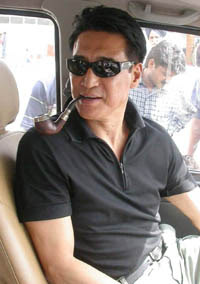
Original Name: Devdutt Pishorimal Anand
Date of Birth (Birthday): 26 September, 1923
Zodiac Sign: Libra
Eye Color: Black
Hair Color: Black
Birth Place: Gurdaspur, Punjab
Religion: Hindu
Education: English literature from the Government College, Lahore
Marital Status: Married
Languages: Hindi, English
Contact Address: Navketan Films Anand, 42 Pali Hill Zig Zag Road, Bandra(W), Mumbai 400 050
Dev was born Dharam Dev Pishorimal Anand on 26 September 1923[6] in the Shakargarh tehsil of the Gurdaspur district in Punjab (British India)
(present-day Narowal district of Pakistan). His father Pishori Lal
Anand was a well-to-do advocate. Dev was the third of four sons born to
Pishori Lal Anand. One of Dev's younger sister is Sheela Kanta Kapur,
who is mother of Shekhar Kapur. His older brothers were Manmohan Anand (Advocate, Gurdaspur Dist. Court) and Chetan Anand and younger one was Vijay Anand.
Dev Anand spent his early years in Gharota village near Gurdaspur,
Gurdaspur town. He did his schooling till matriculation from Sacred
Heart School, Dalhousie, Himachal Pradesh (then in Punjab) and went to college Dharamsala in Himachal Pradesh before going to Lahore to study.[7][8] Later Dev completed BA degree in English Literature from the Government College, Lahore in British India.

Career
After completing BA degree in English Literature from the Government College, Lahore (then in British India, now in Pakistan),Dev Anand left his hometown for Bombay in the early 1940s. He began his career in the military censor's office at Churchgate, for a monthly salary of Rs. 165. Later he joined as a clerk in an accountancy firm for a salary of Rs. 85.[9]
He joined his older brother, Chetan, as a member of the Indian People's
Theatre Association (IPTA).Dev Anand aspired to become a performer
after seeing Ashok Kumar's performance in films like Achhut Kanya and
Kismat.[10]
Dev Anand quoted in an interview that "I remember when I gatecrashed
into the office of the man who gave me the first break, he kept looking
at me – Babu Rao Pai of Prabhat Film Studios. At that time he made up
his mind that this boy deserves a break and later mentioned to his
people that ‘this boy struck me because of his smile and beautiful eyes
and his tremendous confidence."[11] Then he was soon offered the lead role in Prabhat Films' Hum Ek Hain (1946), a film about Hindu-Muslim unity, where Dev Anand played a Hindu boy and was paired opposite Kamala Kotnis.[12] While shooting the film in Pune, Anand befriended the actor Guru Dutt.
Between them, they agreed that if one of them was to become successful
in the film industry, they would help the other to be successful. They
formed a mutual understanding that when Anand produced a film, Dutt
would direct it and when Dutt directed a film, Anand would act in it.[13]
Late 40s and romance with Suraiya


In the late 1940s, Anand was offered a few roles starring as the male lead opposite singer-actress Suraiya
in woman-oriented films. He considered himself to be very lucky to get a
chance to star opposite such an established actress and accepted the
offers. While shooting these films, he became romantically involved with
Suraiya. The two of them were paired in seven films together: Vidya (1948), Jeet (1949), Shair (1949), Afsar (1950), Nili (1950), Do Sitare (1951) and Sanam
(1951), all of which were successful at the box office. In these films,
Suraiya was always first-biller in the credits, indicating that she was
a bigger star than Anand. She fell in love with him during the shooting
of the song Kinare kinare chale jayen ge from the film Vidya—while
shooting the scene, the boat they were in capsized, and Anand saved
Suraiya from drowning. Their entire affair was conducted in a
clandestine manner, with friends like Durga Khote and Kamini Kaushal
going out of their way to engineer secret rendezvous. On the sets of the
film Jeet, Anand finally proposed to Suraiya and gave her a
diamond ring worth Rs 3,000. Her maternal grandmother opposed the
relationship as they were Muslim and Anand was Hindu, and so, Suraiya
remained unmarried. They stopped acting together after her grandmother
opposed their partnership, and Do Sitare was the last film in which they appeared.[14][15]
Although the films he starred in with Suraiya had been successful, the
producers and directors of those films attributed their success to the
acting prowess and screen presence of Suraiya. Anand began looking for
an opportunity to play the main male lead in a film where his acting
skills could be demonstrated, so as to dispel scepticism about his
acting abilities.
Break and the 1950s
Anand was offered his first big break by Ashok Kumar. He spotted Anand hanging around in the studios and picked him as the hero for the Bombay Talkies production, Ziddi (1948), co-starring Kamini Kaushal, which became an instant success. After Ziddi's success, Anand decided that he would start producing films. It was in the film Ziddi, where the first-ever Kishore-Lata duet, Yeh Kaun Aaya Karke Yeh Sola Singhar, was recorded.[16]
This duet was an instant hit, and from here, on both the playback
singers' association with Dev Anand began. It continued for next four
decades. His association with Kishore Kumar started when the former sang
the first solo of his playback singing career – Marne Ki Duayen – picturised on Dev Anand in the movie Ziddi. Dev had forged a very strong bond of friendship with Kishore Kumar during the making of the film. In 1949, he launched his own company Navketan Films (which means "newness"), which, as of 2011, had produced 35 films.[17]
Dev chose Guru Dutt as director for the crime thriller, Baazi
(1951). The film, starring Dev Anand, Geeta Bali and Kalpana Kartik was
a trendsetter, regarded as the forerunner of the spate of urban crime
films that followed in Bollywood in the 1950s. The film Baazi saw debut of Kalpana Kartik (aka Mona Singh) as the lead female actress and Guru Dutt
as a director. The collaboration was a success at the box office and
the duo of Dev Anand and Kalpana Kartik were offered many films to star
in together. They signed all the film offers and subsequently the movies
Aandhiyan, Taxi Driver, House No. 44 and Nau Do Gyarah went on to become big hits too. During the making of film Taxi Driver, the couple fell in love and Dev proposed marriage to his heroine Kalpana. In 1954, Taxi Driver was declared a hit and the two decided to marry in a quiet ceremony. The couple had a son, Suneil Anand in 1956 and later a daughter, Devina, was born. After her marriage, Kalpana decided not to pursue her acting career further. Nau Do Gyarah was the couple's last movie together.

A rapid-fire style of dialogue delivery and a penchant for nodding while speaking became Dev's style in films like House No. 44, Pocket Maar, Munimji, Funtoosh, C.I.D. and Paying Guest.[18] In the 1950s his films were of the mystery genre or light comedy love stories or were films with social relevance like Ek ke baad ek and Funtoosh.His
style was lapped up by the audience and was widely imitated. He starred
in a string of box office successes for the remainder of the 1950s
opposite newcomer Waheeda Rehman in C.I.D., Solva Saal, Kala Pani, Kala Bazar and Baat Ek Raat Ki. Waheeda first became a star with C.I.D becoming a hit.[19] In 1955 he also co-starred with Dilip Kumar in Insaniyat. With his acting in Kala Pani
(1958), as the son who is willing to go to any lengths to clear his
framed father's name, he won his first Filmfare award for Best Actor for
the film.[20] He attempted films of tragic genre occasionally like Pocket Maar (1956), Kala Pani (1958), Bombai Ka Baboo (1960) and Sharabi (1964) and tasted success with them. Dev also played a few characters with a negative shade, like in Jaal(1952) where he played a smuggler, then as an absconding gang member in Dushman, as a black marketer in Kala Bazar.[21] Apart from his pair with Suraiya and Kalpana Kartik, his pair with Nutan and Waheeda Rehman was popular among the audiences in late 50’s and 60’s. His films Rahee and Aandhiyaan, were screened along with Raj Kapoor's Awaara. From the early fifties till mid sixties, the trio of Dilip Kumar, Raj Kapoor and Dev Anand ruled the roost.
Romance hero image in the 60s
In the sixties, Dev Anand acquired a romantic image with films like Manzil and Tere Ghar Ke Samne with Nutan, Kinaare Kinaare with Meena Kumari, Maya with Mala Sinha, Asli-Naqli with Sadhana Shivdasani, Jab Pyar Kisi Se Hota Hai and Mahal with Asha Parekh and Teen Deviyaan opposite three heroines Kalpana, Simi Garewal and Nanda. In the film Teen Deviyaan, Dev Anand played a playboy.
His first colour film, Guide with Waheeda Rehman was based on the novel of the same name by R. K. Narayan.
Dev Anand himself was the impetus for making the film version of the
book. He met and persuaded Narayan to give his assent to the project.[22] Dev Anand tapped his friends in Hollywood to launch an Indo-US co-production that was shot in Hindi and English simultaneously and was released in 1965. Guide,
directed by younger brother Vijay Anand, was an acclaimed movie. Dev
played Raju, a voluble guide, who supports Rosy (Waheeda) in her bid for
freedom. He is not above thoughtlessly exploiting her for personal
gains. Combining style with substance, he gave an affecting performance
as a man grappling with his emotions in his passage through love, shame
and salvation.
He reunited with Vijay Anand for the movie Jewel Thief, based on thriller genre which featured Vyjayanthimala, Tanuja, Anju Mahendru, Faryal and Helen and was very successful. Their next collaboration, Johny Mera Naam (1970), again a thriller, where Dev was paired opposite Hema Malini was a big hit.[19] It was Johnny Mera Naam which made Hema Malini a big star.[23]
In 1969 he was a member of the jury at the 6th Moscow International Film Festival.[24]
Directorial debut and the 70s
His directorial debut, the espionage drama Prem Pujari,
was a flop but has developed a cult following over the years.The film
introduced Zaheeda and had Waheeda Rahman as the lead female artiste. He
tasted success with his 1971 directorial effort, Hare Rama Hare Krishna which talked about the prevalent hippie culture. His find Zeenat Aman,
who played the mini-skirt sporting, pot-smoking Janice, became an
overnight sensation. Dev also became known as a filmmaker of trenchantly
topical themes. This same year, he starred with Mumtaz in Tere Mere Sapne, an adaptation of A. J. Cronin's novel, The Citadel. The film was directed by Dev's brother, Vijay and was also successful. In 1971 he paired again with Zaheeda in Gambler which went on to become a success.
In the 1970s, Raj Kapoor started playing roles of father in films like Kal Aaj Aur Kal in 1971 and Dharam Karam in 1974 and had put lot of weight and films with Dilip Kumar
as lead hero were failures at the box office . Some of the
hurriedly-made films with Dev Anand as the leading man—three each
opposite Hema Malini and Zeenat Aman and Yeh Gulistaan Hamara
with Sharmila Tagore became flops and posed a threat to his career as
leading man. But he delivered commercial hits again with young heroines Yogeeta Bali and Raakhee in Banarasi Babu (1973), Hema Malini in Chhupa Rustam (1973) and Amir Garib (1974),[25] Zeenat Aman in Heera Panna(1973), Warrant(1975)[26] and Darling Darling(1977) and Parveen Babi in Bullet(1976). The presence of his discoveries in the 1970s—Zeenat, and later Tina Munim, in films and his good onscreen chemistry with beautiful young stars like Raakhee, Parveen Babi, Hema Malini, Zeenat Aman in various films boosted Dev's image as the evergreen star even though he was well into his fifties.
Political activism during the Emergency in the late 70s
Dev Anand has also been politically active. He led a group of film personalities who stood up against the Internal Emergency imposed by the then Prime Minister of India, Indira Gandhi.
He actively campaigned against her with his supporters in Indian
parliamentary elections in 1977. He also formed a party called the "National Party of India", which he later disbanded.
The 1978 hit Des Pardes, directed by Dev Anand was the debut movie of actress Tina Munim
and this film’s success gave him the tag of evergreen hero. He was 55
but he shared very good chemistry with the 20-year old Tina Munim. Dev
Anand was offered lead role in Man Pasand by director Basu Chatterjee. Dev Anand’s successful run at the box office continued in the 1980s with Man Pasand, Lootmaar (both opposite Tina Munim), Swami Dada (1982) being both critically acclaimed and box office hits.
Later career
Though Dev Anand’s demand as the lead hero had not decreased even in
the 1980s, he decided that it was the right time to introduce his son Suneil Anand in films as the hero. He launched his son in the Kramer vs. Kramer inspired Anand Aur Anand (1984), which was produced and directed by Dev Anand himself and had music by R.D. Burman. He expected the film to do well but the film was a box office disaster and Suneil Anand decided not to act in films any more.
But films with Dev Anand as the lead hero Hum Naujawan (1985), Lashkar (1989) continued to be box office success and was appreciated by critics.[27] Awwal Number
(1990), where Dev Anand co-starred with Aamir Khan became an average
grosser. Aamir said in an interview that Awwal Number is the only film
he signed without reading the script because it was being directed by
his senior Dev Anand. Aamir quoted “Dev saab was an icon for many
generations and entertained us throughout his life.[28] He was already 60 years old in 1983 when he acted with Padmini Kolhapure in Swami Dada but looked half his age and shared a good on screen chemistry. In 1989, his directorial venture Sachche ka Bolbala was released. Though critically acclaimed, it was a commercial failure.
Since the 1990s except for Awwal Number, rest of the eight films directed by him were box office failures. But Sau Crore (1991) and Censor (2000) were critically acclaimed. His last film Chargesheet
(2011) was panned by critics across the board. The only two hero film
he acted in were Insaniyat in 1955 with Dilip Kumar and Return of Jewel
Thief with Dharmendra in 1996. He also starred in English films like The
Evil Within(1970) where he was paired opposite Vietnamese actress Kieu
Chinh and Zeenat Aman[9] and Guide (English Version). Off the 114 Hindi films he appeared in 6 decades, Kahin Aur Chal (1968) had a delayed release in early 1970s and multistarrer film Ek Do Teen Chaar (1980) remained unreleased and Shrimanji
(1968) had him in guest appearance and 82 were box office hits and 29
were commercial failures. By 2011, he held the record for being the
second actor from Hindi films who has played the central solo lead
character in maximum films—104, with first being Rajesh Khanna who
played author backed solo lead hero in maximum films 106.
Comparisons with Gregory Peck
Often compared to the famous actor Gregory Peck the world over,[29]
Dev Anand said that he didn't feel ecstatic bearing the tag line
bestowed on him in his hey days. "When you are at an impressionable age
you make idols. But when you grow out of the phase, you develop your own
persona. I don't want to be known as India's Gregory Peck, I am Dev
Anand".[30]
Acquainted to the Bollywood actor, Peck's personal interactions with
him spanned four to five long meetings in Europe and Mumbai.[30][31][32]
Dev Anand and Suraiya met Peck for the first time at Mumbai's
Willingdon Club,after the Filmfare Awards in 1954, on Peck's stopover in
the city from a schedule at Sri Lanka after shooting for Purple Plane.
He knew of the 'Indian Star' as an actor, more so probably because of
his romance with Suraiya was grabbing the headlines, and they had a
chat. The second time they met in Rome when Dev Anand was on his way
back from the Venice Film Festival, he visited him on the sets of Roman
Holiday. "I was returning from the Venice film fest. I stopped my car
and joined the crowd watching the shoot, hoping that his eyes would fall
on me. As expected, he nodded and I walked up to him. He remembered me
and we exchanged pleasantries." The third meeting was at London on the
sets of Moby Dick. However, Suraiya asked for an exclusive meeting with
her idol at her house. Though Anand says jealousy was natural for anyone
in love, he didn't mind that he was not invited. "I didn't quite feel
anything. It wasn't as if they were going to fall in love or make love.
Even if they would have, it wouldn't have mattered. I was mature enough.
Moreover, he wasn't my rival. I too was a big star by then," says
Anand.
Critical appraisal
Dev Anand has directed 19 films and produced 35 films of which 7
directorial ventures and 18 films respectively were commercially
successful at the box office. He wrote the story for 13 of his films.
Critics say his directorial ventures have always been ahead of its time.
Dev Anand's films are well known for their hit songs. He is known to
have been an active participant in the music sessions of a number of his
films. His association with music composers Shankar-Jaikishen, O. P. Nayyar, Kalyanji-Anandji, Sachin Dev Burman and his son Rahul Dev Burman, lyricists Hasrat Jaipuri, Majrooh Sultanpuri, Neeraj, Shailendra, Anand Bakshi, and playback singers Mohammed Rafi, Hemant Kumar and Kishore Kumar
produced some very popular songs. S.D Burman, R.D Burman, Rafi, Pran
and Kishore Kumar were his closest friends from film industry.[33][34]
In September 2007, Dev's own autobiography Romancing with Life was released at a birthday party with the Indian Prime Minister Dr. Manmohan Singh.[35] In February 2011, his 1961 black and white film Hum Dono was digitised and colourised and released.
Dev Anand is credited with giving actors like Zarina Wahab in Ishq Ishq Ishq, Jackie Shroff in Swami Dada, Tabu in Hum Naujawan and Richa Sharma(Sanjay Dutt’s first wife) a break into the film industry, discovered Zeenat Amaan, Tina Munim and encouraging music composer Rajesh Roshan.[9]
Amit Khanna started his career with Navketan as executive producer in
1971 and had been secretary to Dev Anand in 70's. He adds, "The
uniqueness of Navketan today is that it's the only film company in the
world still run by the one who started it."[36]
Shatrughan Sinha disclosed in an interview that it was Dev Anand who
gave him a break in films by giving a role in 'Prem Pujari' and since
Dev had given Sinha a very small role in that film, he compensated for
it by giving Sinha another role in his next film 'Gambler'. Sinha quoted
"Later on we worked together in 'Sharif Badmash' and it was really a
privilege to work with him,".[37]
It was under Dev Anand's Navketan Banner where Guru Dutt, Raj Khosla,
Waheeda Rahman, S.D. Burman, Jaidev, Sahir Ludhianvi, Majrooh
Sultanpuri, Yash Johar, Shekhar Kapur, Kabir Bedi were given breaks into
Hindi films and Dev launched actors Zaheera, Zaheeda Hussain, Zarina Wahab, Natasha Sinha, Ekta Sohini, Sabrina.
Death
Dev Anand died in his room at The Washington Mayfair Hotel in London at the age of 88 on 3 December 2011 (4 December 2011 by Indian Standard Time) of a cardiac arrest.[38][39][40] His death came just months after the release of his last film, Charge Sheet.[41] Anand was reportedly in London for a medical check up at the time of his death.[42] Condolences poured in from all corners of the Indian film industry, with most of them remembering his positive attitude towards life.[41][43]
On 10 December, his funeral service was held at a small chapel in
London after which his casket was taken to the Putney Vale Crematorium
in South West London for cremation. His ashes were returned to India for
immersion burial in the Godavari River.[44]
Awards, honours and recognitions
Civilian award
- 2001 – Padma Bhushan (India's third highest civilian award from the Government of India)[45]
National Film Awards
Winner
- 1965 – National Film Award for Best Feature Film in Hindi for Guide
- 2002 – Dadasaheb Phalke Award, India's highest award for cinematic excellence[46]
Filmfare Awards
Winner
- 1959 – Best Actor for Kala Pani[47]
- 1967 – Best Film for Guide[48]
- 1967 – Best Actor for Guide[48]
- 1991 – Filmfare Lifetime Achievement Award[49]
National honours and recognitions
- 1996 – Star Screen Lifetime Achievement Award
- 1997 – Mumbai Academy of Moving Images Award for his Outstanding Services to the Indian Film Industry
- 1998 – Lifetime Achievement Award by the Ujala Anandlok Film Awards Committee in Calcutta[50]
- 1999 – Sansui Lifetime Achievement Award for his 'Immense Contribution to Indian Cinema' in New Delhi[51]
- 2000 – Film Goers' Mega Movie Maestro of the Millennium Award in Mumbai[52]
- 2001 – Special Screen Award for his contribution to Indian cinema
- 2001 – Evergreen Star of the Millennium Award at the Zee Gold Bollywood Awards on 28 April 2001 at the Nassau Coliseum, New York[53]
- 2003 – Lifetime Achievement Award for "Outstanding Achievement in Indian Cinema" at IIFA Award in Johannesburg, South Africa[54]
- 2004 – Legend of Indian Cinema Award at Atlantic City (United States)[55]
- 2004 – Living Legend Award by the Federation of Indian Chamber of Commerce and Industry (FICCI) in recognition of his contribution to the Indian entertainment industry[56]
- 2005 – Sony Golden Glory Award[57]
- 2006 – ANR National Award by the Akkineni International Foundation[58]
- 2006 – Glory of India Award by IIAF, London[59]
- 2007 – Punjab Ratan (Jewel of Punjab) Award by the World Punjabi Organisation (European Division) for his outstanding contribution in the field of art and entertainment.[60]
- 2008 – Lifetime Achievement Award by Ramya Cultural Academy in association with Vinmusiclub[61]
- 2008 – Lifetime Achievement Award by Rotary Club of Bombay[62]
- 2008 – Awarded at the IIJS Solitaire Awards[63]
- 2009 – Outstanding contribution to Indian cinema at the Max Stardust Awards[64]
- 2009 – Legend Award was given to Dev Anand by Rajnikanth[65]
- 2010 – Phalke Ratna Award by Dadasaheb Phalke Academy[66]
- 2010 – Rashtriya Gaurav Award[67]
- 2011 – Rashtriya Kishore Kumar Samman from the Government of Madhya Pradesh[68]
- 2011 – NDTV Indian of the Year's Lifetime Achievement Award with Rahul Dravid[69]
International honours and recognitions
- In July 2000, in New York City, he was honoured by an Award at the hands of the then First Lady of the United States of America, Hillary Rodham Clinton, for his 'Outstanding Contribution to Indian Cinema'.[70]
- In 2000, he was awarded the Indo-American Association "Star of the Millennium" Award in the Silicon Valley, California.
- Donna Ferrar, Member New York State Assembly, honoured him with a "New York State Assembly Citation" for his 'Outstanding Contribution to the Cinematic Arts Worthy of the Esteem and Gratitude of the Great State of New York' on 1 May 2001.
- In 2005, he was honoured with a "Special National Film Award" by the Government of Nepal at Nepal’s first NationIndian film festival in Stockholm.
- In 2008, he was guest of honour at a dinner hosted by the Provost of Highland Council in Inverness, Scotland to celebrate 10 years since he first worked in the Scottish Highlands. He spent several days in the area, en route to Cannes, as a guest of the Highlands and Islands Film Commission.
Filmography
Actor
| Year | Film | Role | Notes and awards and nominations details | |||
|---|---|---|---|---|---|---|
| 1946 | Hum Ek Hain (1946 film) | This was debut film, offered to him by Prabhat Talkies. | ||||
| 1947 | Mohan | |||||
| Aage Badho | ||||||
| 1948 | Ziddi | This film was Dev Anand's "big break" in the film industry. It was offered to him by his favorite actor, Ashok Kumar. Interestingly, Ashok Kumar's brother, Kishore Kumar, sung his first complete song (for Dev Anand) here, and the two would later become very close friends. Before Ziddi, Kishore sang a few lines in 'Aath Din' (1946) under music director SD Burman. | ||||
| Vidya | Chandrashekhar (Chandu) | |||||
| Hum Bhi Insaan Hain | ||||||
| 1949 | Udhaar | |||||
| Shayar | ||||||
| Shair | ||||||
| Jeet | Vijay | |||||
| 1950 | Nirala | Anand | ||||
| Nili | ||||||
| Madhubala | ||||||
| Khel | ||||||
| Hindustan Hamara | ||||||
| Dilruba | ||||||
| Birha Ki Raat | ||||||
| Afsar | Kapur | This was the first film from Dev Anand's production house, Navketan films. It flopped at the box office. | ||||
| 1951 | Stage | |||||
| Sazaa | Ashok | |||||
| Sanam | ||||||
| Nadaan | ||||||
| Do Sitare | ||||||
| Baazi | Madan | This was Guru Dutt's directorial debut and a huge success, and Dev Anand shot to stardom with this film. It led to the spate of crime thrillers that the film industry churned out in the 1950s. | ||||
| Aaram | Shyam | |||||
| 1952 | Zalzala | |||||
| Tamasha | Dilip | |||||
| Jaal | Tony | |||||
| Aandhiyan | Ram Mohan | |||||
| 1953 | Rahi | Ramesh | ||||
| Patita | Nirmal Chander | |||||
| Humsafar | ||||||
| Armaan | ||||||
| 1954 | Taxi Driver | Mangal | Dev and Kalpana Kartik had a quiet marriage on the sets of this movie. | |||
| Kashti | ||||||
| Baadbaan | Naren | Munimji(1954) | Amar/Raj/Kala Ghoda | Nominated - Filmfare Award for Best Actor | ||
| 1955 | ||||||
| Milap | Rajender Sayal | |||||
| Insaniyat | Bhanu | |||||
| House No. 44 | Ashok | |||||
| Faraar | Gora | |||||
| 1956 | Pocket Maar | Roshan | ||||
| Funtoosh | Ram Lal "Funtoosh" | |||||
| C.I.D. | Insp. Shekhar | |||||
| Paying Guest | Ramesh/Mirza | This was the first film to star Dev Anand and Nutan together. The two would later become a popular screen couple. | ||||
| 1957 | Nau Do Gyarah | Madan Gopal | This was Vijay Anand's, Dev Anand's brother, directional debut. | |||
| Dushman | ||||||
| Baarish | Ramu | |||||
| 1958 | Solva Saal | Prannath Kashyap | ||||
| Kala Pani | Karan Mehra | Winner - Filmfare Award for Best Actor | ||||
| Amar Deep | Ashok | |||||
| 1959 | Love Marriage | Sunil Kumar/Sonu | Nominated - Filmfare Award for Best Actor | |||
| 1960 | Sarhad | |||||
| Manzil | Raju | |||||
| Kala Bazar | Raghuvir | Nominated - Filmfare Award for Best Actor | ||||
| Jaali Note | Insp. Dinesh | |||||
| Ek Ke Baad Ek | ||||||
| Bombai Ka Baboo | Babu/Kundan | |||||
| 1961 | Roop Ki Rani Choron Ka Raja | |||||
| Maya | ||||||
| Jab Pyar Kisi Se Hota Hai | Sunder/Popat Lal/Monto | |||||
| Hum Dono | Capt. Anand/Major. Manohar Lal Verma | Nominated - Filmfare Award for Best Actor | ||||
| 1962 | Baat Ek Raat Ki | Rajeshwar | ||||
| Asli-Naqli | Anand | |||||
| 1963 | Tere Ghar Ke Samne | Rakesh Anand Kumar | This was his last film together with Nutan. | |||
| Kinare Kinare | ||||||
| 1964 | Sharabi | Keshav | ||||
| 1965 | Teen Devian | Devdutt Anand | ||||
| Guide | Raju | This film is based on R.K.Narayan's Sahitya Akademi winning novel "The Guide". An English version, with the screenplay by Nobel Laureate Pearl S Buck, was also released. Dev Anand won the Filmfare Best Actor Award for his performance in this film. | ||||
| 1966 | Pyar Mohabbat | Naresh Kumar Singh/Dilip Singh | ||||
| 1967 | Jewel Thief | Vinay/Prince Amar | ||||
| 1968 | Kahin Aur Chal | Unreleased film | ||||
| Duniya | Amarnath 'Amar' Sharma | |||||
| 1969 | Mahal | |||||
| 1970 | The Evil Within | English film | ||||
| Prem Pujari | Ramdev Bakshi/Peter Andrews/Yik Tok | Directional Debut | ||||
| Johny Mera Naam | Johny/Sohan | |||||
| 1971 | Gambler (film) | Raja | ||||
| Tere Mere Sapne | Dr. Anand Kumar | |||||
| Haré Raama Haré Krishna | Prashant Jaiswal | |||||
| 1972 | Yeh Gulistan Hamara | Vijay | ||||
| 1973 | Shareef Budmaash | Rocky/Inspector Ramesh/Sustram | ||||
| Heera Panna | Heera Bhandari | |||||
| Banarasi Babu | Sohan Lal/Mohan | |||||
| Chhupa Rustam | Ashwini Kumar/Natwarlal/Chhupa Rustam | |||||
| Joshila | Amar | |||||
| 1974 | Prem Shastra | Sagar Sharma | ||||
| Ishq Ishq Ishq | Dhun/Ravi Vyas | |||||
| Amir Garib | Manmohan/Moni/Bhagula Bhagat | |||||
| 1975 | Warrant | Jailer Arun Mishra | ||||
| 1976 | Darling Darling | |||||
| Jaanemann | Ronnie | |||||
| Bullet | Dharam Dev | |||||
| 1977 | Saheb Bahadur | Prem Pratap | ||||
| Kalabaaz | Vijay | |||||
| 1978 | Des Pardes | Veer Sahni | ||||
| 1980 | Lootmaar | Wing Commander Bhagat/Jim Darcy | ||||
| Man Pasand | Pratap | |||||
| 1982 | Swami Dada | Hari Mohan/Swami Dada | ||||
| 1984 | Anand Aur Anand | Arun Anand | ||||
| 1986 | Hum Naujawan | Professor Hans | ||||
| 1989 | Sachché Ká Bol-Bálá | Karan Kaul | ||||
| Lashkar | ||||||
| 1990 | Awwal Number | DIG Vikram Singh | ||||
| 1991 | Sau Crore | |||||
| 1993 | Pyar Ka Tarana | |||||
| 1995 | Gangster | Father Pereira | ||||
| 1996 | Return of Jewel Thief | Vinay Kumar | ||||
| 1998 | Main Solah Baras Ki | |||||
| 2001 | Censor | Vikramjeet 'Vicky' | ||||
| 2003 | Love at Times Square | Shaan | ||||
| 2005 | Mr Prime Minister | Johny Master | ||||
| 2011 | Charge Sheet[1] |
Producer
| Year | Film | Notes |
|---|---|---|
| 1950 | Afsar | |
| 1951 | Baazi | |
| 1953 | Humsafar | |
| 1955 | House No. 44 | |
| 1956 | Funtoosh | |
| 1958 | Kala Pani | |
| 1960 | Kala Bazar | |
| 1961 | Hum Dono | |
| 1963 | Tere Ghar Ke Samne | |
| 1965 | Guide | |
| 1967 | Jewel Thief | |
| 1970 | Prem Pujari | |
| 1971 | Tere Mere Sapne | |
| 1971 | Haré Raama Haré Krishna | |
| 1973 | Shareef Budmaash | |
| 1973 | Heera Panna | |
| 1974 | Ishq Ishq Ishq | |
| 1976 | Jaaneman | |
| 1978 | Des Pardes | |
| 1980 | Lootmaar | |
| 1982 | Swami Dada | |
| 1984 | Anand Aur Anand | |
| 1990 | Awwal Number | |
| 1993 | Pyaar Ka Tarana | copenhagan |
| 1994 | 1994 | |
| 1998 | Main Solah Baras Ki | |
| 2001 | Censor | |
| 2003 | Love at Times Square | |
| 2005 | Mr Prime Minister | |
| 2011 | Chargesheet[1] |
Director
| Year | Film | Notes |
|---|---|---|
| 1970 | Prem Pujari | |
| 1971 | Haré Raama Haré Krishna | |
| 1973 | Heera Panna | |
| 1974 | Ishq Ishq Ishq | |
| 1978 | Des Pardes | |
| 1980 | Lootmaar | |
| 1982 | Swami Dada | |
| 1984 | Anand Aur Anand | |
| 1985 | Hum Naujawan | |
| 1989 | Sachché Ká Bol-Bálá | |
| 1990 | Awwal Number | |
| 1991 | Sau Crore | |
| 1993 | Pyaar Ka Tarana | |
| 1994 | Gangster | |
| 1998 | Main Solah Baras Ki | |
| 2001 | Censor | |
| 2003 | Love at Times Square | |
| 2005 | Mr Prime Minister | |
| 2011 | Charge Sheet[1] |
Writer
| Year | Film | Notes |
|---|---|---|
| 1978 | Des Pardes |
Further reading
- Cinema Modern: Navketan Story, by Sidharth Bhatia. Harpercollins, 2011. ISBN 978-93-5029-096-5.